
Clinic
Clinical Research: Ongoing Projects
The Healey ALS Platform Trial
This trial is a novel design where multiple drugs will be tested in tandem against one placebo group. If volunteers with ALS meet a universal set of criteria, they are randomized into one of the treatments. The criteria are broader than we have had for most trials and allow wider access for PALS and the chances of treatment are higher than traditional trials as the placebo group is shared between them. The first 5 drugs were 1) Zilucoplan (UCB); 2) Verdiperstat (Biohaven Pharmaceuticals); 3) CNM-Au8 (Clene Nanomedicine, Inc); 4) Pripodine (Prilenia Therapeutics); and 5) Trehalose (Seelos Therapeutics). The 6th drug, 6) ABBV-CLS-7262 (Calico), targets eIF2B, a key regulator of the integrated stress response; 7) DNL343 (Denali), DNL343 is an investigational CNS-penetrant small molecule integrated stress response (ISR) inhibitor designed to activate the eukaryotic initiation factor 2B (eIF2B) and suppress aberrant ISR activation. Enrollment is currently completed for the 6th and 7th drug regimens.
ROAR DiGAP
Several years ago, in partnership with patients, Dr. Richard Bedlack of Duke University started a novel program called ROAR (Replication of ALS Reversals). This consists of small pilot trials of vitamins and supplements that are associated with cases of recovery from ALS (“ALS Reversals”). Unlike more traditional trials, ROAR trials are widely inclusive and have historical rather than placebo controls (all enrolled patients get the treatment under study at no cost to them). While this program has not yet found a treatment that reverses ALS, its trials enroll and get answers quickly and at a fraction of the cost of most other trials.
We are thrilled to be partnering with Dr. Bedlack on his next ROAR trial. This will utilize a new technology called DiGAP (deep integrated genomics analysis platform) to determine which of 4 biochemical pathways is most likely killing motor neurons in each enrolled patient. Based on this, each patient will receive a personalized treatment tailored to their own biology. Each of the 4 treatments being offered is associated with at least one ALS Reversal. Enrollment is complete for this trial.
In addition, the clinic is actively helping to find new ways to diagnose disease, track the progression, and study the response to treatment. The following studies are open to enrollment at the MDA/ALS Center of Hope.
Oxidative Stress Response in Different ALS Types
In a recent study, Radicava (edaravone) has demonstrated slowing of disease progression in ALS. It has been shown to inhibit motor neuron death in animal models by reducing oxidative stress. Given that oxidative stress plays a role in ALS; there is evidence that Radicava can affect disease progression by reducing oxidative stress. Biomarkers of oxidative stress and antioxidant capacity can be measured in body fluids (plasma, cerebrospinal fluid (CSF), and urine), thus the effect of Radicava on oxidative stress can be evaluated in a systematic way by comparing levels before and after treatment over time and compared to changes in an untreated population of PALS. The purpose of this study is to determine if different types of motor neuron involvement in PALS vary in baseline levels of oxidative stress and whether any subgroup has a selective benefit as measured by a series of oxidative markers.
Natural History of ALS
As part of the ALS Natural History Consortium we are collecting clinical data on people with ALS and other motor neuron diseases that attend the Center of Hope and entering the de-identified information into a large multicenter database called Neurobank. This data will allow comprehensive characterization of the clinical picture of ALS and allow us to study the disease and characteristics that will predict outcomes, stratify populations, as well enable clinical studies. By using a global identifier for each clinical record, the clinical data can be tied to clinical samples.
PLS Natural History Study
The goal of the PLS Natural History study is to advance the current research state of PLS by generating collecting clinical data and biological samples over time to understand the natural progression of the disease. This will advance development of future research and clinical trials. If you consent to participate in this study, you will have study visits every 3 months for 1 year and a final study visit at 2 years (24 months). Visits 2 (3 month follow up), 4 (month 9) and 6 (month 24) will occur over the phone and visits 3 (month 6) and 5 (month 12) will be in-person. In addition to collection of clinical data relevant to PLS an electromyography (EMG) test will be performed at visit 5 (month 12).
MDA MOVR Data Hub
The Muscular Dystrophy Association (MDA) wants to collect information about people with neuromuscular diseases to better understand their natural disease progression and ultimately improve their medical care, quality of life and survival. If you consent to participate in this study, you will be asked to provide clinical information from your medical chart so long as you are being followed at our clinic (you can withdrawal at any time). The information collected from your medical chart and provided by you will be stored in a protected database called the MDA MOVR Data Hub.
Tissue Bank
In a disease like ALS in which the cause is unknown, no animal models of ALS can substitute for understanding how it affects humans. We are currently collecting blood, urine, CSF and autopsy materials from people with ALS and other motor neuron diseases to look for clues in the human tissue. All samples are tied to de-identified clinical information in a database to help maximize the usefulness of this precious resource. This includes demographic information; environmental exposures; and medical history. This will increase availability of human tissue for research with pertinent corresponding clinical information.
Predictors of Respiratory Events in ALS
The goal of the PALS Cohort study is to understand if certain characteristics of ALS specific to you may help predict the risk of developing problems with breathing and whether they determine how well breathing function will be over time. The study will be enrolling people who have been diagnosed with ALS in the past 5 months prior to enrolling in the study. If you consent to participate in this study, clinical data relevant to your diagnosis, vital signs, breathings test results and use of non-invasive ventilation or NIV (breathing equipment) and tracheostomy placement will be collected at 5 clinic visits over about 12 months. A secondary goal, through an optional sub-study, is to gather patient concerns, expectations, and knowledge regarding early respiratory care in ALS. This includes an approximately 30 minutes recorded, transcribed and de-identified phone call.
Evaluation of GI Symptoms in ALS
The gastrointestinal (GI) tract has a wide array of symptoms that has been investigated in ALS. This may include gastric motility and delayed emptying indicating autonomic dysfunction that may occur in patients with ALS. Some of the typical symptoms frequently experienced include constipation and bloating and may be attributed to decreased physical activity, dysphagia resulting in inadequate fiber intake, or dehydration. It is important to adequately determine the frequency by which these symptoms are experienced by ALS patients. Evaluation of symptoms will consist of completing a questionnaire.
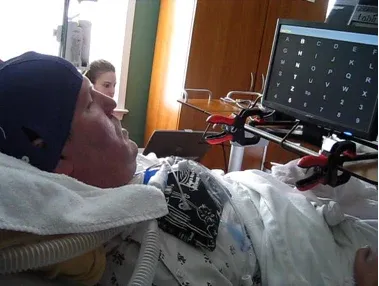
The following are projects aimed at evaluating the effectiveness of some of these new technology developments for communication and control for individuals with ALS.
EEG-Based Brain-Computer Interface
By using EEG (brain wave) signals from the scalp to create a signal, the Brain-Computer Interface (BCI) allows people to make selections from the computer screen. The study is intended to evaluate both the complexity of the system and the degree to which each participant will be able to communicate. Trials will consist of asking the subject to follow a series of simple instructions and to complete certain tasks while using the BCI. This study is open for enrollment.
Assessing Assistive Technology Use and Needs
The purpose of this study is to assess the current assistive technology use and needs of people living with amyotrophic lateral sclerosis (ALS) and other neuromuscular diseases. This data will be used to determine the level of familiarity and effectiveness of this technology. Our hypothesis is that there are 1) gaps in the information that people with neuromuscular diagnosis have about assistive technology and that there are 2) areas of need for AT that are not being addressed by designers. This information gathered can then be used to 1) develop educational resources to provide information to individuals who need the AT and 2) provide a resource to individuals developing AT to address the needs of their target population. This study is open for enrollment.
Key Terms
- Biomarkers
- Distinct biochemical, genetic or molecular characteristic that is an indicator of a disease
- PALS
- Person living with ALS Placebo: A control substance given with no therapeutic or treatment effects expected
- Placebo-controlled
- Trials with two groups of people, those who receive the medication or treatment being tested and those who receive a placebo treatment.
- Randomized
- Participants are selected to be placed by chance, like in the flip of a coin, to either the placebo or active treatment group